

Where to Store Furniture During a Home Renovation
Home renovations can quickly make your house feel crowded.
Furniture may need to move out of rooms so contractors have enough space to work. Large items can also get in the way during flooring, painting, remodeling, or other renovation work.
If you do not have enough space elsewhere in your home, temporary storage can give your furniture a place to stay until the work is finished.
The right choice depends on how much furniture needs to move, how long it will be out, how often you need access to it, and what space you already have at home.
First, Decide What Actually Needs to Leave
You may not need to move every item in your house.
Start with the areas being renovated. Look at which furniture and belongings need to be removed so the work area stays clear.
For example, a living room renovation may require you to move a sectional, chairs, tables, cabinets, rugs, and other belongings.
A bedroom renovation may require beds, mattresses, dressers, and other furniture to leave the room.
A whole-house renovation is different. You may need to move belongings from several rooms at once.
This first step matters because the amount of furniture you need to relocate will affect the storage space you need.
Once you know what has to leave, you can decide where it should go.
Where Can You Put Furniture During a Renovation?
There is no single storage solution for every renovation. Your available space and project size should guide the choice.
| Option | When it may work |
| Another room | You have enough unused space inside the home |
| Garage or basement | The space is large enough for your belongings |
| Family or friends | You only need to move a smaller amount |
| Portable storage | You want storage kept close to the property |
| Self-storage | You need more off-site space during the renovation |
If you are renovating only one room and have plenty of unused space elsewhere, moving furniture within the house may be enough.
But that option becomes harder when several rooms are affected.
A full garage can also remove one of the easiest places to put furniture. And keeping furniture close to an active work area may not give you the separation you need.
That is when temporary off-site storage can become useful.
When Does Temporary Self-Storage Make More Sense?
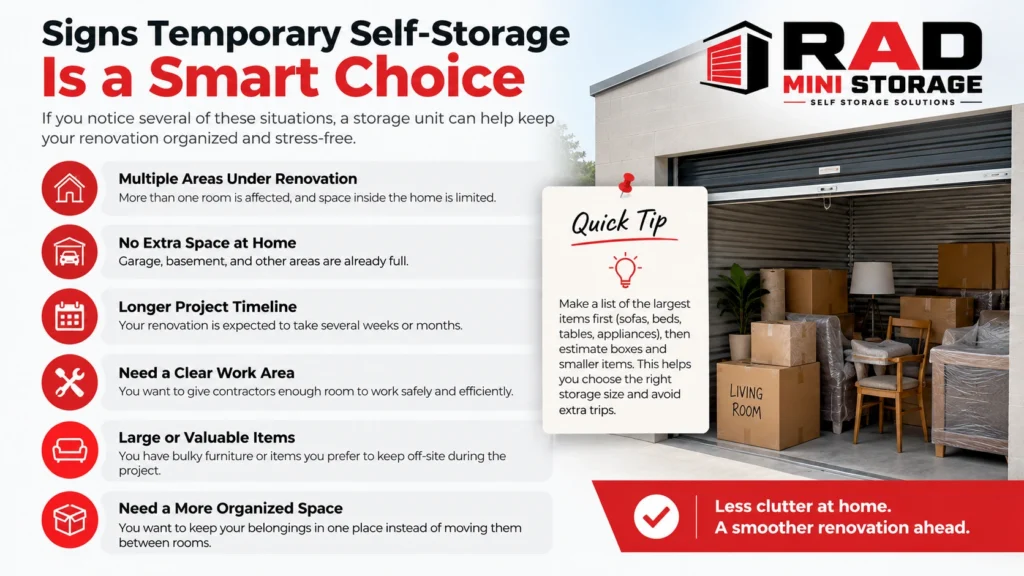
A storage unit can make sense when your home does not have enough suitable space for the furniture you need to move.
This may be the case when several rooms are being renovated, your garage is already full, or you need to clear a large work area.
It can also help when furniture needs to stay out of the house for several weeks or months and you do not have another suitable place for it.
For example, imagine you are remodeling your kitchen and living room at the same time. You have a sectional, dining table, chairs, cabinets, and several boxes. Your garage is already full.
Trying to move everything into another room may simply create a new problem.
A temporary storage unit gives those belongings a separate place while the renovation is underway.
The goal is not to store everything automatically. The goal is to move the items that need to be out of the way.
How Much Storage Space Will You Need?
The amount of storage space depends on what you actually need to store.
Start with an inventory rather than choosing a unit based only on the number of rooms in your house.
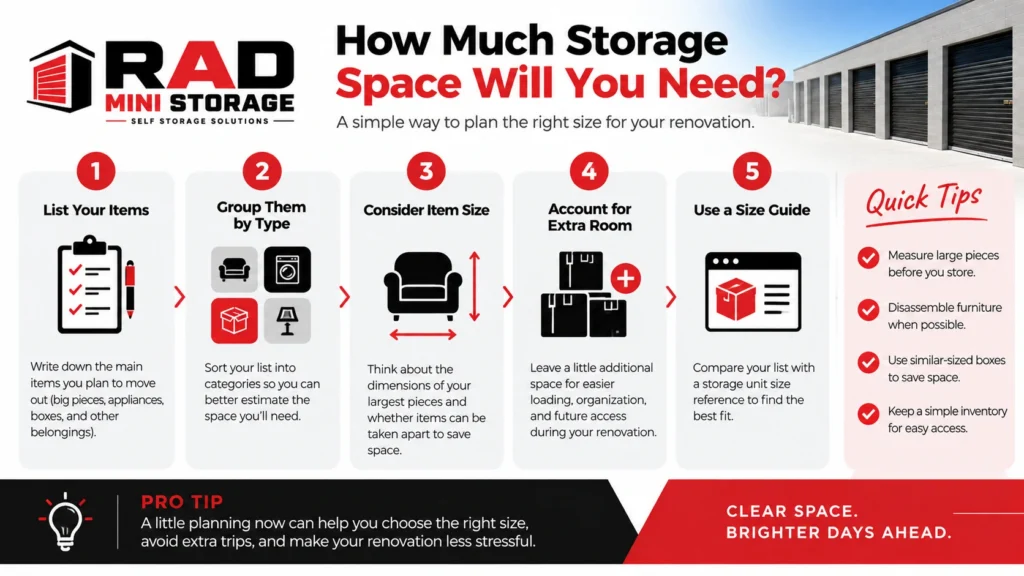
Think about four groups:
- Large furniture: sofas, beds, dressers, dining tables, cabinets, and similar items.
- Bulky household items: appliances and other large belongings.
- Boxes and bins: smaller items removed from rooms.
- Other belongings: anything else that must leave the renovation area.
Then ask yourself:
Do I need to store everything from the affected rooms, or only the items that cannot stay in the house?
That answer can make a big difference.
Furniture can also be disassembled when appropriate. This may make some pieces easier to arrange in storage.
Once you have an idea of your inventory, the storage unit sizes guide can help you understand how different storage sizes relate to the amount of space you need.
You do not need to calculate every item perfectly. A clear list of your largest furniture, bulky items, boxes, and other belongings gives you a much better starting point.
Plan Storage Around Your Renovation
Choosing a storage location is only part of the job. You also need to think about how storage fits into your renovation timeline.
Consider How Long You Will Need It
A short project may only require temporary storage for a few weeks.
A larger renovation can take longer, especially when several rooms are involved.
Before renting, consider your expected project length and allow some flexibility if the renovation schedule changes.
Think About How Often You Need Your Furniture
Some belongings can stay untouched until the renovation ends.
Others may need to be accessed during the project.
If you expect to visit your stored belongings regularly, convenient access becomes more important.
If you are moving furniture into storage as part of the project, it also helps to follow a clear packing, moving, and storing process so the transition is easier.
Keep Furniture Away From the Work Area
Renovation work can create dust, debris, paint, and other mess around the active work area.
Moving furniture away from that area can help keep the workspace clear and reduce the chance of your belongings being exposed to renovation activity.
The sooner you know which rooms need to be cleared, the easier it is to plan where those belongings will go.
RAD Mini Storage in Imperial, CA
If you need temporary off-site space during a renovation, RAD Mini Storage offers storage units in Imperial, California.
The facility has multiple unit sizes, including larger options for households with a significant amount of furniture and belongings.
RAD units have Drive-Up Access and ground-floor access, which can make loading and unloading large items more convenient. The facility also provides 24/7 unit access, a gated and fenced property, recorded video surveillance, and online rent and payment options.
If these features matter for your renovation project, you can learn more about RAD’s 24-hour access and security features.
Before choosing a unit, you can also check the current storage unit prices in Imperial, CA to understand the local rental options.
Once you know how much space you need, you can view available storage units and choose an option that fits your renovation plans.
FAQs
Should I move all my furniture out during a renovation?
Not always. Move the furniture and belongings that need to leave the renovation area. If you have enough suitable space elsewhere in your home, some items may be able to stay there.
Can I keep furniture in another room during a renovation?
Yes, if the room has enough space and will not interfere with the renovation. For larger projects, another room may not provide enough space.
Is a storage unit a good option during a home renovation?
It can be useful when you need more off-site space, especially if several rooms are being renovated or your garage and other storage areas are already full.
How do I know what size storage unit I need?
Start with an inventory of the furniture, bulky belongings, boxes, and other items you need to store. Then use the amount and type of belongings to choose an appropriate unit size.
Bottom Line
The right place to store furniture during a renovation depends on your project and the space you already have.
If you can safely move furniture to another room, garage, or basement, you may not need outside storage. If your home cannot hold everything comfortably, temporary self-storage can give your furniture a separate place until the renovation is complete.
The key is to decide what needs to leave, how much space those belongings require, and how often you need to access them before choosing a storage solution.


