
What Size Storage Unit Do You Need for a 1-Bedroom Apartment?
Imagine a family preparing to move out of a one-bedroom apartment. The bed is coming apart, and boxes are stacking up near the front door. Meanwhile, the sofa and dining table still need a place to go. They need enough storage space for the move, but they do not want to pay for a unit that is much larger than their belongings require.
Note: this is an illustrative moving scenario, not a documented RAD Mini Storage customer story.
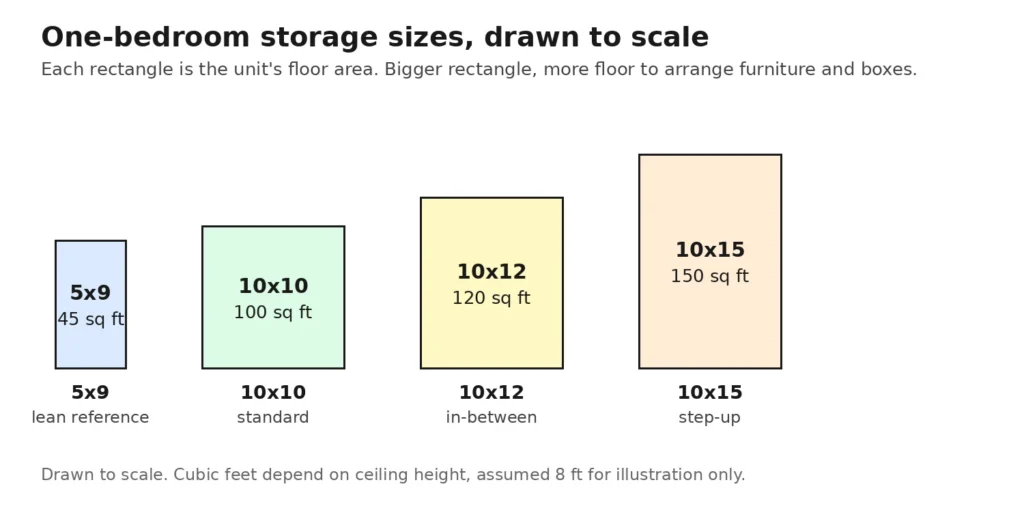
For a typical one-bedroom apartment inventory, a 10×10 storage unit is a practical starting point. It provides 100 square feet of floor area and has a verified monthly rate of $99 at RAD Mini Storage. A 10×12 offers 120 square feet for $109 per month when the extra room helps with furniture placement or access. A 10×15 provides 150 square feet for $129 per month when you have more bulky belongings. Each listed monthly rate is subject to a $29 non-refundable administration fee and a required tenant protection plan starting at $10/month. For an overview of all sizes, see the storage unit sizes guide.
Compare the sizes at a glance
The table below compares the sizes discussed in this guide, including the 5×9 as a planning reference.
| Unit size | Floor area | What it suits | Monthly rate |
|---|---|---|---|
| 5×9 | 45 sq ft | Lean inventory reference | No rate quoted. Check current availability |
| 10×10 | 100 sq ft | Standard starting point for a typical one-bedroom inventory | $99 |
| 10×12 | 120 sq ft | Intermediate option when the 10×10 layout is too tight | $109 |
| 10×15 | 150 sq ft | Step-up option for a larger inventory | $129 |
A note on the 5×9 size
The 5×9 appears in RAD’s size-guide information but is not listed in the live rental widget. For current availability, see the RAD Mini Storage rental page. The 5×9 is included as a planning reference, not a confirmed rental recommendation. No 5×9 rate is quoted anywhere, and no current-availability claim is made.
When to choose a 10×10
A 10×10 offers 100 square feet and is a reasonable starting point for a typical one-bedroom inventory. List the major pieces before choosing. A 10×10 may be sufficient when furniture fits a compact arrangement and the remaining boxes fit around it.
When the extra space of a 10×12 is worth considering
A 10×12 offers 120 square feet, 20 square feet more than a 10×10, at a verified rate of $109 per month. That additional space may be useful when your planned layout has a specific constraint. For example, imagine that the bed, sofa, dresser, and dining table already use most of the practical floor area in your 10×10 plan. If you also need to store a desk and several bookcases, the larger footprint may give you more options for arranging the load. The decision should come from the layout, not the number of items alone, so draw a simple floor plan.
When to step up to a 10×15
A 10×15 offers 150 square feet at a verified rate of $129 per month. Several large furniture pieces combined with extra shelving and many boxes may require it. The 10×15 costs $20 more per month than the 10×12 and $30 more per month than the 10×10. For more detail, see the 10×15 storage unit guide.
Estimate your boxes room by room
Use the room-by-room ranges below as an illustrative estimate. The range is deliberately broad because household contents vary, and the count must be used alongside a separate furniture inventory: a load with 30 boxes and several large furniture pieces is not the same as 30 boxes alone.
| Room or area | Illustrative boxes |
|---|---|
| Bedroom | 6-12 |
| Living room | 4-10 |
| Kitchen and pantry | 6-12 |
| Bathroom and linen storage | 2-5 |
| Hallway, closets, and miscellaneous items | 4-10 |
| Illustrative total | 22-49 boxes |
To refine the estimate, use three steps: count boxes already packed and estimate remaining boxes room by room; measure the largest furniture pieces in the form you plan to store them; and check whether the planned arrangement leaves enough room for the access you need. A high box count alone does not establish that a larger unit is needed.
Compare floor area and estimated cubic feet
The volumes below are conditional on an assumed 8-foot ceiling for illustration only, and are explicitly not a statement about RAD Mini Storage’s actual ceiling height. Furniture dimensions, stacking limits, packing materials, and access space affect how efficiently the volume is used.
| Unit size | Floor area | Estimated volume at an assumed 8-foot ceiling |
|---|---|---|
| 5×9 | 45 sq ft | 360 cu ft |
| 10×10 | 100 sq ft | 800 cu ft |
| 10×12 | 120 sq ft | 960 cu ft |
| 10×15 | 150 sq ft | 1,200 cu ft |
Worked example: a 10×12 has a floor area of 10 x 12, or 120 square feet; with an assumed 8-foot ceiling, 10 x 12 x 8 = 960 cubic feet. The calculation demonstrates the method under the stated assumption and does not establish the facility’s actual ceiling height.
Moving-truck loads as a rough planning reference
A moving truck’s advertised capacity can provide a rough reference for the amount of belongings you have, but it does not establish that the load will fit a particular storage unit. Use the actual dimensions and volume of your furniture and boxes, then compare them with the unit’s floor area and the arrangement you need.
How much floor space does an aisle use?
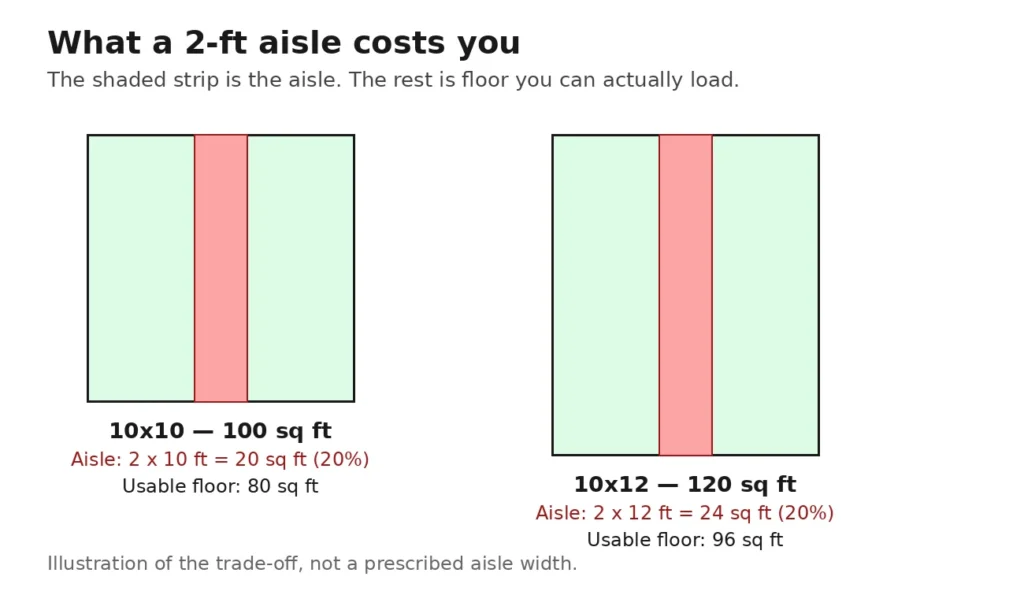
In a 10×10 unit, a 2-foot aisle running the 10-foot depth uses 2 ft x 10 ft = 20 square feet, which is 20% of the 100 square feet. In a 10×12 unit, a 2-foot aisle running the 12-foot depth uses 2 ft x 12 ft = 24 square feet, also 20% of the 120 square feet. These are illustrations of the trade-off, not a prescribed aisle width or a fixed deduction.
Should you disassemble furniture before storage?
Disassembly can help in some cases, but it does not guarantee that a smaller unit will work. For example, a bed frame with removable rails may be easier to arrange when its components are taken apart, and a dining table follows the same logic. To test the idea, measure each large item as it will enter the unit, then recalculate using the smaller component dimensions. If the revised arrangement leaves enough room for belongings and access, the 10×10 may remain sufficient.
Compare monthly rates and additional costs
| Unit size | Monthly rate | Additional costs |
|---|---|---|
| 10×10 | $99/month | $29 non-refundable administration fee; required tenant protection plan starting at $10/month |
| 10×12 | $109/month | $29 non-refundable administration fee; required tenant protection plan starting at $10/month |
| 10×15 | $129/month | $29 non-refundable administration fee; required tenant protection plan starting at $10/month |
The 10×12 costs $10 more per month than the 10×10. The 10×15 costs $20 more per month than the 10×12, and $30 more per month than the 10×10. No verified 5×9 rate is provided; since the live rental widget does not list a 5×9, readers are directed to check the rental page.
Storage in Imperial and the Imperial Valley
RAD Mini Storage is located at 611 E 12th St, Imperial, CA 92251, and can be reached at +1 (442) 236-4057. People in Imperial, El Centro, Brawley, and elsewhere in the Imperial Valley can use the facility details to evaluate the option. Prepare the inventory, compare it with the size options, and check the RAD Mini Storage rental page for current availability and rental details.
Choose a size based on your belongings
For a one-bedroom apartment, begin with a furniture inventory and a room-by-room box estimate. A 10×10 is a practical standard starting point. A 10×12 is the intermediate option when the additional floor area improves the layout. A 10×15 is the step-up option when the larger inventory needs more space. Treat 5×9 as a lean-size planning reference until its current availability is confirmed; check the rental page before deciding.
Frequently asked questions
What size storage unit is usually suitable for a one-bedroom apartment?
A 10×10 storage unit is a practical starting point for a typical one-bedroom apartment. It provides 100 square feet of floor area at $99 per month, subject to the $29 non-refundable administration fee and the required tenant protection plan starting at $10/month.
Is a 10×12 worth considering instead of a 10×10?
Consider a 10×12 when your planned 10×10 arrangement leaves too little space for the furniture, boxes, or access you need. It adds 20 square feet of floor area for $10 more per month. Measure your largest items and test the layout before deciding.
How many boxes should I plan for?
Plan on a range of 22 to 49 boxes from the room-by-room estimate. Your actual total depends on your possessions and how you pack.
Should I choose a 10×15 if I have large furniture?
Consider a 10×15 if several bulky pieces and additional belongings cannot be arranged comfortably in a smaller unit.
Is a 5×9 storage unit currently available at RAD Mini Storage?
The live rental widget does not list a 5×9 unit; do not assume it is available; check the rental page.


