
What Size Storage Unit for a 2-Bedroom Apartment?
Imagine someone preparing to move out of a two-bedroom apartment. The beds and sofa need a place to go, while boxes are piling up around the dining table. There may also be a desk, extra appliances, or patio furniture to store. The challenge is finding enough room for the entire load without paying for more space than the move requires.
This is an illustrative moving scenario, not a documented RAD Mini Storage customer story.
For a two-bedroom apartment, a 10×10 storage unit may work for a light, carefully packed load. A 10×15 is a stronger starting point for a typical or full load, especially if you need room to reach your belongings. A 10×20 may suit a fuller load with substantial overflow or bulky extras.
Your decision depends on the actual inventory and how you plan to use the unit. Measure the largest pieces first, then estimate the boxes. If you will need belongings while they are stored, factor retrieval into the layout.
What size storage unit do you need for a 2-bedroom apartment?
Use this comparison as a starting point. The best fit depends on your belongings and how you arrange them. Access needs matter too: if you will retrieve items while they are stored, size accordingly.
| Storage unit | Floor area | Best fit | Monthly rate |
|---|---|---|---|
| 10×10 | 100 sq ft | Light load, packed efficiently, with little or no aisle | $99 |
| 10×12 | 120 sq ft | Additional boxes or furniture beyond a light load, after checking the actual fit | $109 |
| 10×15 | 150 sq ft | Typical or full apartment load, especially when an access aisle matters | $129 |
| 10×17 | 170 sq ft | An option to assess when a 10×15 needs more room | Check current rate |
| 10×20 | 200 sq ft | Full load with substantial overflow or bulky extras | $169 |
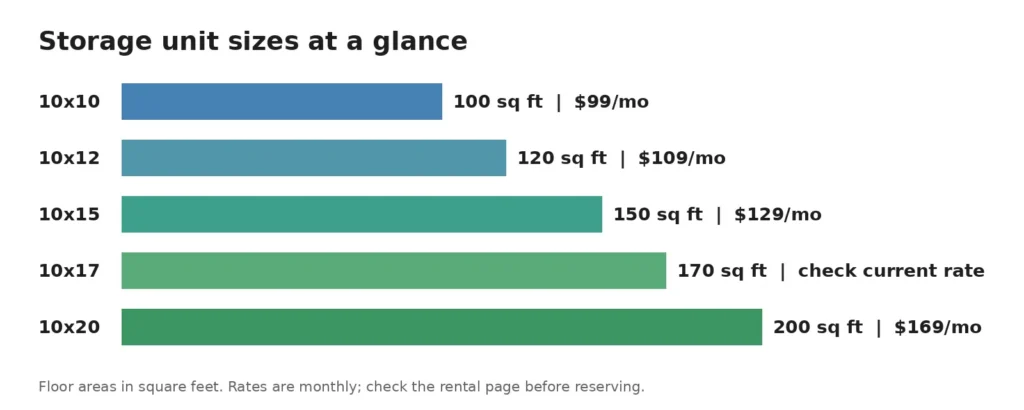
Rates are monthly and should be checked before renting. The listed prices do not include the additional charges explained below.
What do these sizes mean in cubic feet?
Cubic capacity depends on ceiling height. At an assumed 8-foot ceiling, the listed units would provide the following theoretical volumes.
| Storage unit | Floor area | Cubic capacity at an assumed 8-foot ceiling |
|---|---|---|
| 10×10 | 100 sq ft | 800 cu ft |
| 10×12 | 120 sq ft | 960 cu ft |
| 10×15 | 150 sq ft | 1,200 cu ft |
| 10×17 | 170 sq ft | 1,360 cu ft |
| 10×20 | 200 sq ft | 1,600 cu ft |
These are planning calculations, not verified measurements of RAD Mini Storage’s ceiling height. Cubic capacity alone does not establish whether a particular collection of furniture will fit.
When is a 10×10 enough?
A 10×10 provides 100 square feet of floor area. It may work when the apartment has a light load, large furniture can be disassembled, and the belongings can be packed tightly.
Before choosing this size, measure the beds and sofa. Then account for dressers, dining furniture, appliances, and the expected boxes. If you need a clear aisle through the unit, reassess the layout before deciding.
The 10×10 storage unit guide provides more detail about this size.
When should you consider a 10×12?
A 10×12 provides 120 square feet of floor area. Assess it when your planned load feels too tight for a 10×10 after you measure the largest items.
This size may suit a load with additional boxes or furniture beyond a light, efficiently packed inventory, provided the fuller set of items does not point toward a 10×15. It is also worth comparing when you need an access path and want to check whether the actual load can fit around it.
Box estimates can help with this decision. If the expected box volume already strains your 10×10 plan, the 10×12 deserves consideration. These are conditional planning prompts, not universal capacity thresholds.
When is a 10×15 the better choice?
A 10×15 provides 150 square feet of floor area. It is a stronger starting point for a typical or full two-bedroom apartment load, particularly when you want an aisle for retrieval.
Consider this size when the inventory includes two bedroom sets, living-room furniture, dining furniture, dressers, boxes, and additional household items. A large sectional or extra appliances may also push the decision toward a 10×15.
Review the 10×15 storage unit guide for more detail.
What about a 10×17?
RAD’s 10×17 is another size to assess when you want more floor area than a 10×15 offers. It provides 170 square feet.
The rate has not been verified for this guide. Check the current rate before comparing its cost with the other options.
When should you consider a 10×20?
A 10×20 provides 200 square feet of floor area. It may suit a full apartment load with substantial overflow.
Consider this size when you have bulky extras such as a large sectional, patio furniture, a dining set with a hutch, or a home-office setup. Extra business inventory or a large amount of garage overflow can also affect the decision.
A washer and dryer alone do not automatically mean you need a 10×20. Assess the full inventory before choosing.
How do you estimate the space your belongings need?
Start with the largest pieces because their shape can affect how everything else fits. The supplied research estimates that an L-shaped sectional can occupy about 60-80 square feet of floor footprint. A king mattress with its box spring is estimated at about 40 square feet.
These are footprint estimates for individual items. They do not establish how much storage-unit floor area those items will need after they are positioned for storage. Their shapes, orientation, and the space around them affect the final layout.
Make a list of your bedroom furniture, living-room furniture, dining set, appliances, and remaining household belongings. Measure bulky pieces rather than estimating them from photographs.
A worked cubic-feet planning example
This is an illustrative planning example, not a measurement at RAD Mini Storage.
Imagine a two-bedroom apartment inventory containing two beds, a sofa, dining furniture, dressers, appliances, and N medium boxes.
For this example, assume each medium box occupies approximately 3 cubic feet. The box portion of the estimate is therefore: Box volume = 3N cu ft.
The furniture and appliance portion must be measured or estimated separately. The supplied research does not provide verified cubic volumes for every item in this inventory, so this example does not assign invented cubic-foot figures to the furniture.
| Planning component | How to estimate it |
|---|---|
| Medium boxes | Number of boxes x 3 cu ft |
| Beds and sofa | Measure the items and estimate their packed volume |
| Dining furniture and dressers | Measure the pieces in their planned storage arrangement |
| Appliances | Measure each appliance and account for its storage position |
| Total planning estimate | Add the measured or estimated item volumes to the box volume |
The unit comparison at an assumed 8-foot ceiling is:
| Unit | Theoretical volume at assumed 8-foot ceiling |
|---|---|
| 10×10 | 800 cu ft |
| 10×12 | 960 cu ft |
| 10×15 | 1,200 cu ft |
These capacities are reference points for planning. They do not guarantee that the inventory will fit, because furniture shape and stacking affect the layout.
An aisle also consumes floor area. A load may fit by total cubic volume but still be awkward to arrange if the furniture leaves no practical access path. Measure the largest items and test the planned arrangement before treating the estimate as a final size decision.
How many boxes fit in each storage unit?
Box capacity changes with box size, furniture, packing arrangement, and aisle space. The figures below use medium boxes of approximately 3 cubic feet each.
The 10×20 reference comes from the supplied Mountaineer research: about 200 boxes alone, or 110-130 boxes with furniture. The estimates for smaller sizes below are derived by scaling that reference according to floor area. They are illustrative estimates, not sourced capacities.
| Unit | Boxes alone | Boxes with furniture | Aisle condition |
|---|---|---|---|
| 10×10 | About 100 medium boxes | About 55-65 medium boxes | Derived estimates assume no aisle |
| 10×12 | About 120 medium boxes | About 66-78 medium boxes | Derived estimates assume no aisle |
| 10×15 | About 150 medium boxes | About 83-98 medium boxes | Derived estimates assume no aisle |
| 10×20 | About 200 medium boxes | About 110-130 medium boxes | Supplied research reference; aisle condition not independently verified |
The smaller-unit figures are rough floor-area-scaled estimates based on the 10×20 reference. They are not independently measured or sourced capacities for those sizes. The calculation assumes the same broad reference relationship, but packing efficiency will not necessarily remain the same in each unit.
Floor-area scaling is not a physical packing simulation. It does not model furniture shape, stacking, or awkward gaps. The derived figures also assume no aisle, so adding an aisle reduces the space available for boxes further.
Use these figures as a starting estimate only. Count your boxes by size, then assess the furniture separately before deciding on a unit.
What if your boxes are different sizes?
The estimates above use medium boxes. Approximate volumes for other box sizes are:
| Box type | Approximate volume |
|---|---|
| Small box | 1.5 cu ft |
| Medium box | 3 cu ft |
| Large box | 4.5 cu ft |
A count of large boxes is not equivalent to the same count of small boxes. Record the size of each group when estimating your load. For a wider size comparison, see the storage unit sizes guide.
How does storage-unit space compare with a moving truck?
Truck volume can provide a rough reference for the amount of belongings being moved. It does not establish a direct match between a truck and a storage unit.
The supplied truck figures are:
| Moving truck | Approximate volume |
|---|---|
| 15-foot U-Haul | 764 cu ft |
| 16-foot Penske | 800 cu ft |
| 20-foot truck | About 1,016 cu ft |
| 26-foot truck | 1,682 cu ft |
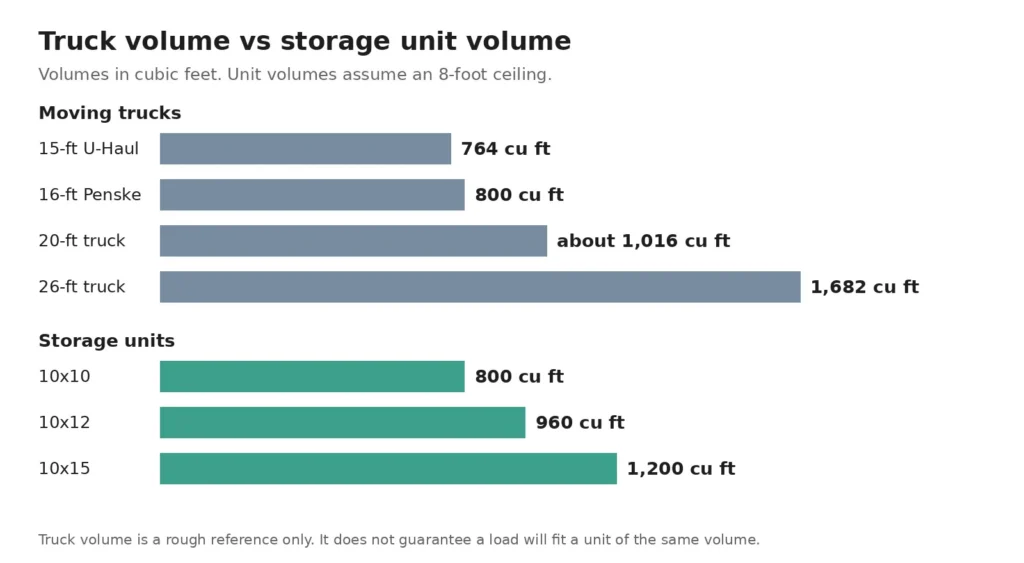
A two-bedroom load estimated at 800-1,200 cubic feet runs from about the volume of a 16-foot truck to more than the volume of a 20-foot truck. A 10×15 unit represents 1,200 cubic feet at an assumed 8-foot ceiling, which exceeds the cited volume of the 20-foot truck.
That comparison is about volume, not a guaranteed fit. A truck and a storage unit have different shapes and loading arrangements. Truck packing density affects how much can be carried, while a storage-unit aisle takes up floor area that could otherwise hold belongings.
Do not choose a storage unit solely by matching its theoretical cubic capacity to a truck’s advertised volume. Consider the actual furniture layout and whether you will need access after loading.
Why does an access aisle affect your storage unit size?
A unit can hold more when every available space is used for storage. However, tight packing may make it difficult to reach belongings near the back.
A 24- to 30-inch aisle is a useful planning reference. The required path depends on your inventory and how you arrange it.
For example, a 2-foot-wide aisle running 15 feet through a 10×15 unit uses 30 square feet. That equals 20% of the unit’s 150-square-foot floor area. A 2.5-foot-wide aisle running the same length uses 37.5 square feet, or 25% of the floor area.
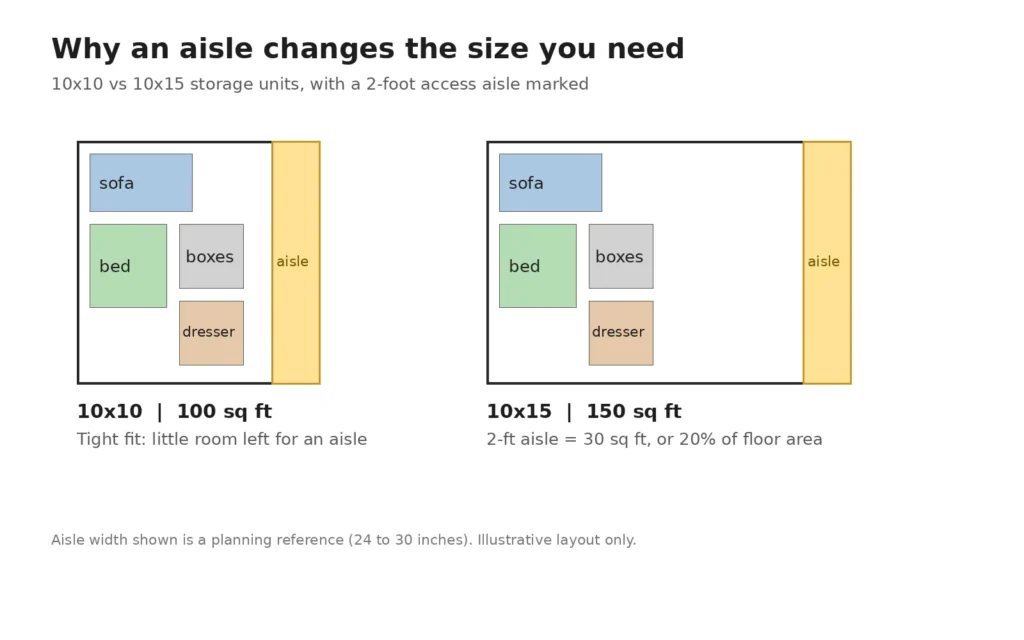
These calculations illustrate the trade-off. They do not mean that the remaining floor area converts directly into usable cubic capacity. Furniture shape and stacking also affect what can fit.
If storage is short-term and you do not expect to retrieve items, tighter packing may work. If you expect frequent access, consider sizing up one step.
How should you pack a two-bedroom apartment into storage?
A basic loading plan helps you decide how much room to leave for retrieval. Before loading, disassemble furniture where appropriate and keep the hardware together in labelled bags.
Plan the load before moving items in
Write down the inventory and measure the largest belongings. Decide which items you will need to retrieve during storage.
Choose the aisle arrangement before the unit fills up. If you expect to access boxes or furniture later, include that path in your size decision.
Load from the back toward the entrance
Place items you will not need soon toward the back. Arrange larger furniture along the walls where practical, and keep boxes stable when stacking them.
Mattresses can be positioned upright along a side wall when appropriate. Disassembled bed frames and dining tables may be easier to arrange than fully assembled furniture. Keep frequently needed belongings closer to the entrance.
Keep an access path if you need one
A 24- to 30-inch path is a useful planning reference, but the final layout depends on the belongings. Do not assume every inventory can accommodate the same aisle width.
RAD Mini Storage has ground-floor units with drive-up access. You can plan to move belongings from the vehicle directly to the unit door. Leave enough room for safe loading and the retrieval needs you identified before moving in.
How much does a storage unit for a two-bedroom apartment cost at RAD Mini Storage?
The monthly rates below come from the supplied RAD pricing information. Check the current rental page before reserving because prices and availability can change.
| Unit size | Listed monthly rate | First-month estimate* |
|---|---|---|
| 10×10 | $99 | $138 |
| 10×12 | $109 | $148 |
| 10×15 | $129 | $168 |
| 10×17 | Rate not verified | Check current rate |
| 10×20 | $169 | $208 |
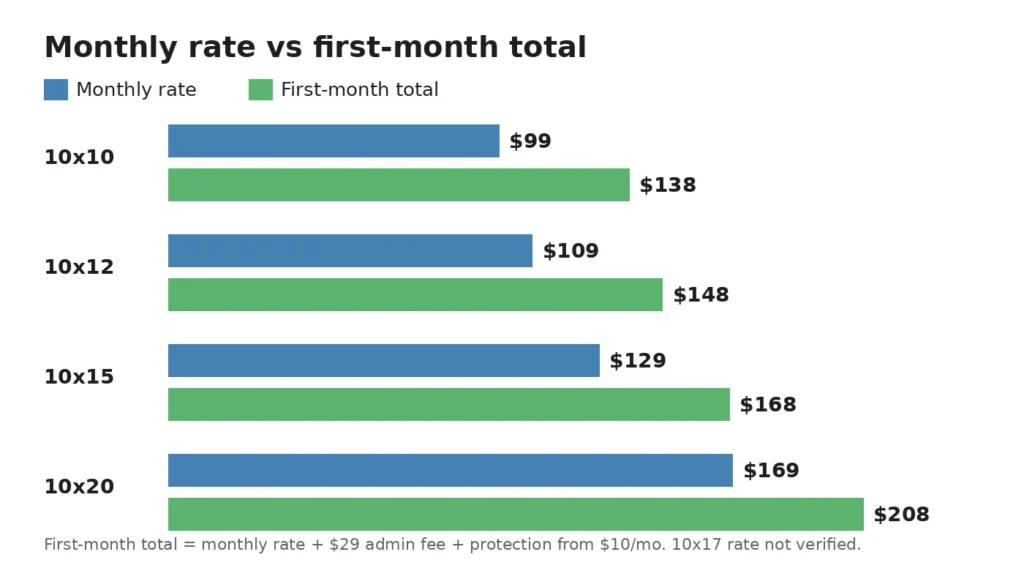
*The first-month estimates for priced sizes add the listed monthly rate, a $29 non-refundable administration fee, and the required tenant protection plan starting at $10 per month. The estimates use the $10 starting amount for the protection plan. Confirm the actual amount due when renting.
The 10×12 costs $10 more per month than the 10×10. The 10×15 costs $20 more per month than the 10×12. Compare those price differences with the space required for your actual load.
The 10×17 rate has not been verified, so it is not included in the priced comparison. Check the RAD Mini Storage rental page for current rates and options.
10×15 vs. 10×20: Which is better for a two-bedroom apartment?
A 10×15 is a sensible starting point for a typical or full apartment load. A 10×20 offers another 50 square feet of floor area, which may matter if the inventory includes substantial overflow.
| Your situation | Starting point to consider |
|---|---|
| Light furniture and tightly packed boxes, with little need for access | 10×10 |
| The measured load strains the 10×10 plan and needs additional room | Assess a 10×12 |
| Two bedroom sets and a typical amount of household furniture | 10×15 |
| Full apartment load with an access aisle | 10×15, then assess the largest items |
| Large sectional, dining set with hutch, patio items, or substantial overflow | Compare 10×15 with 10×20 |
| Extra business inventory or substantial garage overflow | Consider 10×20 |
This is a planning guide, not a guarantee that a particular load will fit. Measure large pieces and estimate your boxes before reserving.
If you are comparing the larger option, read the 10×20 storage unit guide.
What does apartment size tell you about storage needs?
The supplied research gives a two-bedroom apartment range of approximately 800-1,200 square feet, with Extra Space and Homestyler named as sources. It also gives a US typical range of approximately 850-1,100 square feet.
These figures describe apartment size as context. They do not establish how much furniture a household owns or how much of that apartment’s contents will go into storage. Apartment square footage must not be mapped directly to a specific storage-unit size.
Estimate the belongings you intend to store instead. A lightly furnished apartment can have a smaller storage load than a heavily furnished one, regardless of the apartment’s total floor area.
What if you are moving from a one-bedroom or three-bedroom home?
The same load-based approach applies to other home sizes, but the inventory may differ.
If you are moving from a smaller apartment, see the storage unit size guide for a one-bedroom apartment.
It explains how a lighter load can change the decision.
For a larger house, see what size storage unit works for a three-bedroom house.
A house may include additional furniture or garage belongings, so do not assume the same unit size will work for both.
Storage for a two-bedroom apartment in Imperial, California
RAD Mini Storage is located at 611 E 12th St, Imperial, CA 92251. Its ground-floor, drive-up units let renters move belongings from their vehicle directly to the unit door. The facility also offers gated 24/7 access and month-to-month rentals.
If you are moving within Imperial, El Centro, Brawley, or elsewhere in Imperial Valley, estimate the load before selecting a size. Ground-floor drive-up access can help with the loading process, while your expected retrieval needs should guide how tightly you pack the unit.
RAD Mini Storage
611 E 12th St, Imperial, CA 92251
Phone: +1 (442) 236-4057
Frequently asked questions
Is a 10×10 storage unit big enough for a two-bedroom apartment?
It may be enough for a light, efficiently packed load, especially if you do not need an aisle. A full load with two bedroom sets, living-room furniture, dining furniture, appliances, and boxes may need more room. Estimate your inventory before choosing.
When should I upgrade to a 10×15?
Consider a 10×15 when the load is typical or full, when bulky furniture takes up substantial floor space, or when you need an aisle for reaching stored belongings. Measure your largest items and account for the boxes before deciding.
How many boxes fit in a 10×10, 10×12, or 10×15?
The illustrative estimates in this guide use medium boxes of approximately 3 cubic feet. Under the floor-area-scaled, no-aisle estimate, a 10×10 is about 100 boxes alone or 55-65 with furniture; a 10×12 is about 120 alone or 66-78 with furniture; and a 10×15 is about 150 alone or 83-98 with furniture. These are derived estimates, not sourced capacities. Furniture shape, stacking, and an aisle can reduce the practical number.
When do I need a 10×20 instead of a 10×15?
A 10×20 may be a better choice when the load includes substantial overflow, such as a large sectional, a dining set with a hutch, patio furniture, extra household items, or business inventory. A washer and dryer alone do not automatically require a 10×20.
How much does storage cost at RAD Mini Storage?
The listed monthly rates are $99 for a 10×10, $109 for a 10×12, $129 for a 10×15, and $169 for a 10×20. A $29 non-refundable administration fee and a required tenant protection plan starting at $10 per month also apply. The 10×17 rate has not been verified. Check the rental page for current rates and options.
Can I switch to a different unit size later?
Ask RAD Mini Storage about availability and any applicable terms before making a decision. A unit-transfer policy has not been verified for this guide, so do not assume that a transfer will be available.
Choose a unit based on your actual load
A 10×10 may work for a light two-bedroom apartment load. A 10×15 is a stronger starting point for a typical or full load, particularly when you need access to your belongings. A 10×20 may be worth comparing when you have substantial overflow or bulky extras.
Measure the largest items and estimate your boxes before deciding on a size. Check RAD Mini Storage’s current rates and available options before reserving.


